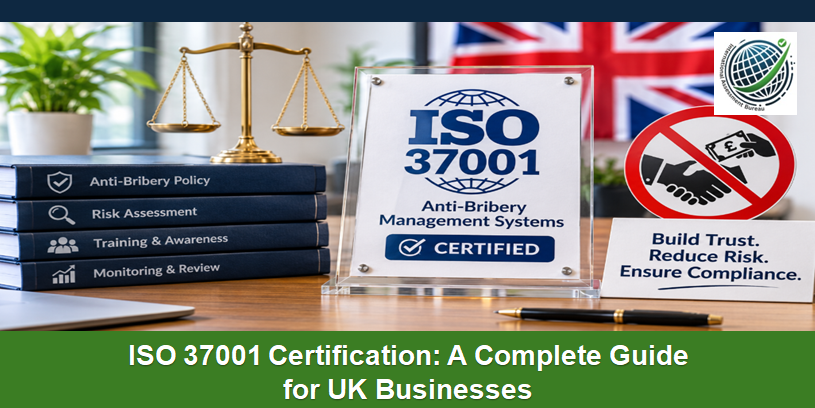
Independent third-party certification against ISO 37001 confirms that your anti-bribery management system (ABMS) has been audited against the requirements of this internationally recognised standard. The risk for a UK-based medical devices manufacturer is usually not a bag of cash. It could be a distributor’s commission, a payment to a clinician for a consultancy, or sponsored attendance at a conference. This guide describes what the standard requires, how an audit against it is conducted, and its relationship to the other management systems and quality systems that you operate.
Which Edition Applies Now
February 2025 saw the release of ISO 37001:2025, the update to the 2016 edition. In line with the International Accreditation Forum’s Transition Rules (IAF MD 30:2025), the cut-off date for first and renewal audits against the 2016 edition was 31 August 2026. Certificates issued against the 2016 edition will expire on 28 February 2027.
Effectively, a first-time applicant will be assessed against the requirements of the 2025 edition of the standard, whereas a current certificate holder will be assessed against the requirements of the 2016 edition for its last renewal and then against the requirements of the 2025 edition for subsequent renewals. Therefore, it is in the interest of a certificate holder to make its renewal an early priority, as the certification body will be busy processing renewals in the lead-up to the 2026 deadline.
There are changes to the requirements of the standard, a few of which are listed below.
- ‘Culture’ has been added to the components of an effective system to manage bribery.
- There is a greater emphasis on independence of the ‘anti-bribery function.’
- The role of senior management and the governing body is expanded.
- Requirements of the context of the organisation are expanded to include climate change.
- Treatment of Conflict of Interest is expanded.
What ISO 37001 Is, and What It Is Not
ISO 37001 sets out requirements and guidance for establishing, implementing, maintaining and improving an Anti-Bribery Management System (ABMS). Bribery is the only offence covered. ISO 37001 certification can be integrated into a broader management system. Certification is voluntary.
MHRA is responsible for regulating devices in the UK, and ISO 37001 certification of a company does not, and should not be interpreted to mean that a device is safe, compliant, or approved. It will not, and should not be interpreted to provide a legal defence.
How It Connects to the UK Bribery Act 2010
Section 7 of the Bribery Act 2010 states that a commercial organisation will be liable for bribery if a person associated with the organisation (such as an agent or a distributor) bribes to obtain or retain business on behalf of that organisation. The defence in this instance is to prove that adequate procedures exist. The Ministry of Justice has published guidance on the topic. It states that adequate procedures can consist of:
- Proportionate procedures
- Top-level commitment
- Risk assessment
- Due diligence
- Communication (including training) and awareness
- Monitoring and review.
While ISO 37001 anti-bribery management systems align closely with the UK firm frameworks, and therefore, can be employed with other standards, the courts assess the sufficiency of procedures on a case-by-case basis. Therefore, while having an ISO 37001 certificate can help your case, it cannot prevent prosecution. The consequences can be severe. Companies can face unlimited fines. Individuals can face up to 10 years in prison. The Serious Fraud Office can become involved for more serious cases.
What the Standard Asks You to Do
- Set the scope. Decide which operations, markets and relationships the system covers.
- Lead by example. Top management endorses and owns the anti-bribery policy.
- Evaluate the risk. Identify where, with whom and how bribery can occur.
- Establish an anti-bribery function. Give it the power and means to report to management.
- Establish controls. This can include various financial, administrative and other controls regarding gifts and hospitality, as well as due diligence.
- Ensure awareness and training. Educate staff and business partners about the expected behaviours and internal controls.
- Raise concerns and act on them. Have systems and mechanisms to raise concerns and address them.
- Continuously improve. This includes management review and corrective action.
Where Bribery Risk Hides in Medical Device Businesses
Risks should be identified in the interactions of money, influence and health care. These may include:
- International distributors and agents paid on commission.
- Restrictive tenders and procurement frameworks by public hospitals.
- Hospitality offered at conferences and training events.
- Consultancy, speaking or advisory positions held by health professionals.
- Free product samples, demonstration units and loaned equipment.
- Grants, donations and sponsorships.
- Intermediaries who assist with customs, licensing or approvals.
- Payments to health care professionals for training or lectures.
- Payments in cash or kind for research, or for the purchase of clinical equipment or services.
None of these is necessarily wrong. The issues are determining the purpose and the value of each, and establishing a record.
Working Alongside ISO 13485
There are similarities between ISO 13485 and ISO 37001, and both cover different elements of documentation, internal audit, management review, and supplier and associate controls, along with corrective and preventative actions. If you already hold an ISO 13485 certificate, much of that discipline also applies. Integrating the standards requires careful mapping, rather than actual copying.
The Certification Journey
There is a defined process for certification. You agree and set the scope, we audit your system, and, if all goes well, issue your certificate. Surveillance audits are then carried out to ensure the certification is valid. There are further details on our certification process page.
Most organisations require months, not weeks, to implement these procedures, particularly if they are large or high risk. Auditors will want to see evidence of the following, for example:
- A documented bribery risk assessment
- An approved Anti-bribery Policy
- Training records
- Due diligence files on key associates
- Gifts and hospitality registers
- Concerns logged and how they were handled
- Records of internal audits and management reviews
The same issues occur repeatedly. Policies are frequently copied from a template and don’t reflect the work being done. Distributors are often not included in risk assessments. Records are often thin. The anti-bribery function has no independence. Some firms treat certification as a finish line as opposed to a continuous improvement mechanism.
Taking the Next Step
If your business deals with agents, distributors or public buyers, a clear anti-bribery system protects both your people and your reputation. International Assessment Bureau is an independent UK certification body that audits organisations against recognised management system standards, including ISO 37001 certification, and offers clear, fixed-fee quotes. To discuss your scope, the edition and the timing, you can request a quote.