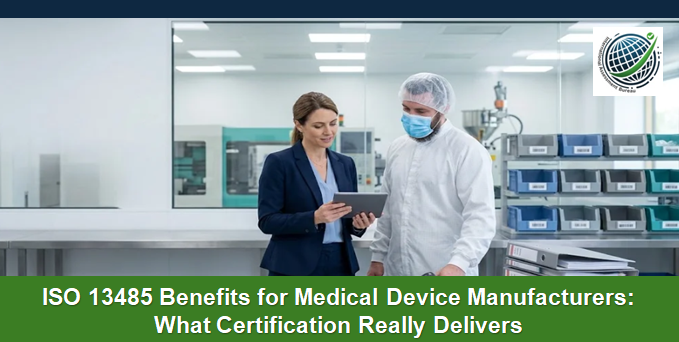
What do manufacturers get out of getting certified for ISO 13485? Like any other management system, manufacturers of medical devices can implement procedures to maintain their QMS. Businesses can manufacture to spec with little to no problems. The customer can verify the system for themselves. Also, the system helps employees pinpoint where the problem is. There are many losses and surprises on the factory floor. The system helps minimise that. The system has many benefits; however, approval of a medical device is not one of them. That process is done through the MHRA.
So what is ISO 13485, exactly?
ISO 13485 is the quality management system for the medical devices industry.
Anyone who has dealt with the ISO 9001 series will see a familiar layout. However, this series takes a lot more interest in patient safety, traceability and controls for things like cleans and sterilisations. If you have an ISO 9001, you will be familiar with several sections of this system.
A common pitfall is understanding that an organisation cannot self-certify. An independent certification audits the system and makes the determination. In Great Britain, it is the MHRA that rules over medical devices and the ISO 13485 system. In the EU, it is the harmonised version of this standard, the EN ISO 13485.
Where the benefits actually show up
Design and production changes stop slipping through
There are several ways that subtle changes can be introduced into design and production and still meet the requirements of ISO 13485. Changes to the supplier of mouldings are an example. A slightly different sterilisation cycle is another. Each of these appears to be unrelated to the other. When introduced on their own, each may appear to be of little or no consequence. However, systems to plan, review, verify and validate design and development and to assess changes prior to their introduction can be good discipline, and help stop complaints from customers six months down the track.
Risk is managed where the work happens.
The requirements of ISO 13485 for risk management are closely tied to the other requirements. The standard requires the use of a risk management process and system to make sure there are effective controls in place for the residual risks that cannot be eliminated. Evidence of the controls and tests is documented and kept with the other records.
Traceability is key
Risks to patient safety are traced to and documented through the design, development and production of the medical device. The traces are then stored for a set period of time. ISO 13485 and ISO 14971 make up the bulk of the risk management system for a medical device company.
Whenever a batch of resin is out of spec, the supplier rings to let you know. Your records link lots to batches, batches to devices and devices to customers, meaning you can answer in an afternoon. Otherwise, you are facing days of guesswork. Complaint handling and corrective and preventive action (CAPA) mean the cause is addressed, not just the symptom.
Suppliers and paperwork under control
There are plenty of device makers that outsource sterilisation, machining, electronics, and software. The standard requires you to assess these suppliers, define what you are purchasing and verify it on-site. Document control sounds dull, but it prevents the use of obsolete procedures.
Customer confidence, within reason
Distributors and tenders often require ISO 13485. While it won't help you win a contract, it stops you from having to answer a lot of supplier questionnaires. Some countries apply additional rules to ISO 13485 for export, and a good base makes dealing with these rules easier.
An illustration, not a case study
Say a ten-person UK firm makes single-use surgical accessories. Sterilisation is outsourced, two suppliers make the moulded parts, and an NHS trust buys through a distributor. Before it has a QMS, batch records sit in separate spreadsheets, and one supplier switches resin grade without mentioning it.
Once ISO 13485 processes are running, supplier changes have to be notified. Incoming inspection picks up the difference, change control kicks in, and the affected batches can be traced. The product hasn’t changed at all. What has changed is that the firm can prove it was in control. This is a made-up example to show the idea, not a real client.
What certification won’t do
It is easy to oversell ISO 13485, so let’s be plain about it. A certificate doesn’t mean your device is approved, and it doesn’t guarantee compliance with every regulation. In Great Britain, devices need to be registered with the MHRA and must meet the UK MDR 2002. UKCA marking applies, and CE-marked devices can still be placed on the GB market under transitional arrangements for a while, so check the latest MHRA guidance for your device. Higher-risk devices need an MHRA-designated UK Approved certification.
Technical documentation, clinical evaluation, labelling and post-market surveillance are separate jobs. ISO 13485 supports them. It doesn’t replace them.
Problems to expect
- Too much paperwork. Write what your processes need and no more.
- Design records that start late. Rebuilding a design history afterwards is miserable.
- Small suppliers who have never been asked for this before.
- Validation of processes such as sealing or sterilisation, and of software used inside the QMS.
- The slump after the certificate arrives, when training, CAPA and records quietly stall.
How the audit works
Certification usually runs in two stages. Stage 1 reviews your documents and checks you are ready. Stage 2 looks at the QMS in operation, either on site or remotely. An independent technical review then confirms the decision, and surveillance audits follow to keep the certificate valid. There is a fuller breakdown on the certification process page.
Before Stage 1, carry out at least one internal audit and a management review. Auditors will ask for both, plus CAPA and complaint records that show real follow-up.
Picking a certification services
Ask a few plain questions. Will your customers and distributors accept the certificate? Is the certification independent, and does it keep certification apart from consultancy? Is the quote clear about audits and yearly surveillance visits? And if your device needs a UK Approved certification, remember that it is a separate designation from ISO 13485 certification.
Where to start
Begin by comparing your current processes with the standard and listing the gaps. Fix those, run an internal audit, then book the independent assessment. International Assessment Bureau is an independent UK certification service in Sunbury-on-Thames that audits and certifies against ISO 13485:2016. If you would like to talk through scope and timing, you can request a quote or get in touch through the website.